On Violence
From "Schizoposting," Part I

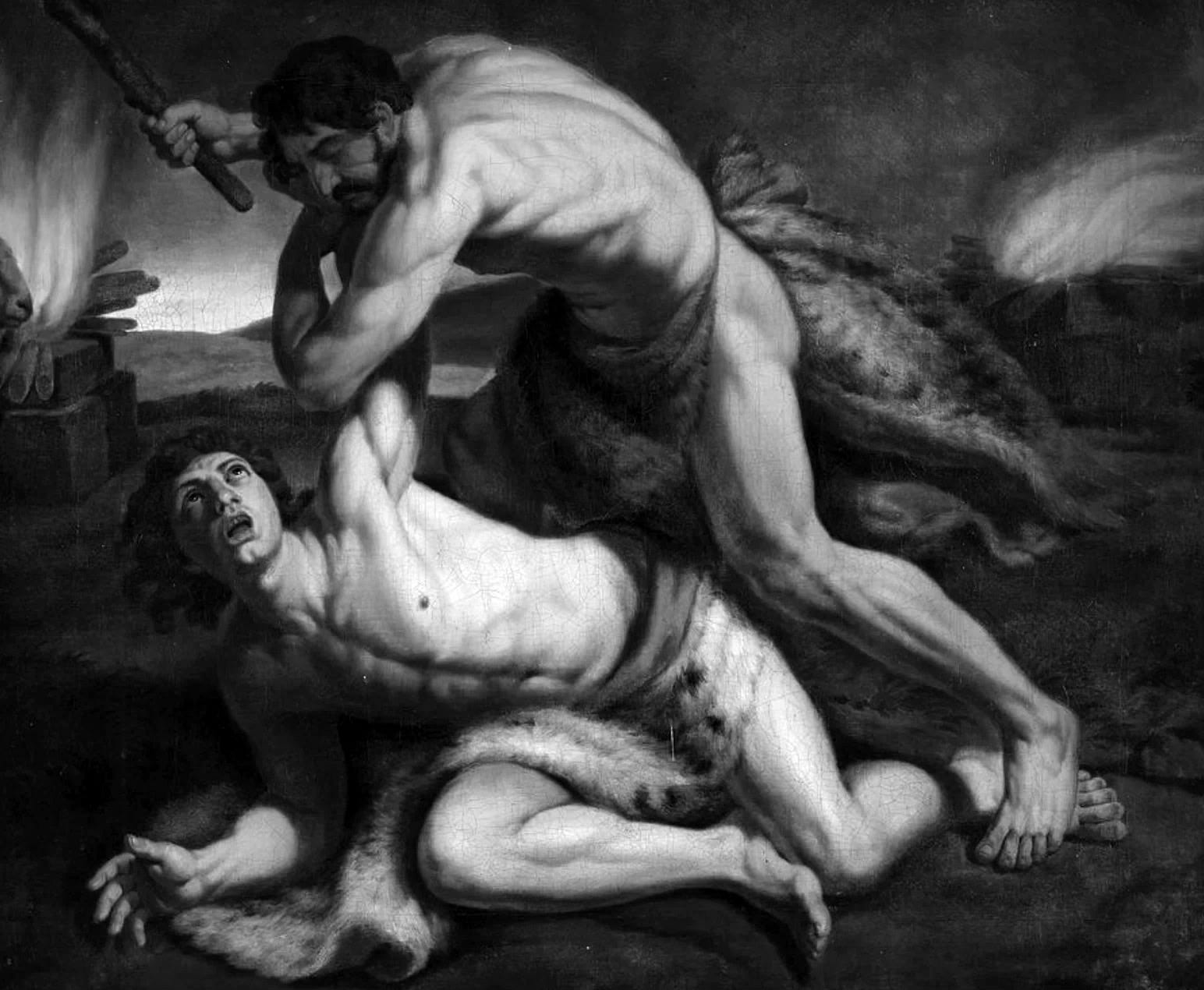
“Since the War’s end, the denial of pain as a necessary facet of life has experienced a late revival. These years display a strange mix of barbarity and humanity; they resemble an archipelago where an isle of vegetarians exists right next to an island of cannibals. An extreme pacifism side by side with an enormous intensification of war preparations, luxurious prisons next to squalid quarters for the unemployed, the abolition of capital punishment by day whilst the Whites and the Reds cut each other’s throats by night—all this is thoroughly fairytale-like and reflects a sordid world in which the semblance of security is preserved in a string of hotel foyers.”
Jünger, On Pain
“Tell me your relation to pain, and I will tell you who you are!” says Jünger, in his famous essay. Pain is essential, making up one of man’s most basic perceptions and therefore a central (if unseen) support-pillar of his identity.
Just as the sensation of pleasure finds its mirror in the action of sex, pain finds its mirror in the action of violence. Few recent histories have examined the role of the latter on a culture-wide scale as extensively as those which have examined sex. And those that have often operate from a moralistic, progressive, or even histrionic standpoint—without recognizing that this, too, is part of a modern and cultural relation to violence, rather than anything inherent to humanity. A man’s relationship to pain and violence speaks to his essence just as a culture’s relationship to pain and violence expresses its core assumptions, and its health. And, just as our relationship to gender and sex becomes increasingly deranged, so too does our relationship to violence. Ultimately the effect is of a distancing from our essential selves—a headlong march away from mankind, and toward a craven image of it.
I: Removal & Derangement
Whether as lament or celebration, the refrain that “violence has been removed from society” has become common. Despite media fictions, this is undeniably true. Steven Pinker’s 2011 work The Better Angels of Our Nature: Why Violence Has Declined offers a rough empirical measure for the whole of human history. In pre-state societies, 500 of 100,000 people died violently, a number which declined to around 100 with the formation of early states, then to around 50 in the Middle Ages. In the modern United States, that number is below ten—and in the most peaceful Western states, below even one.1
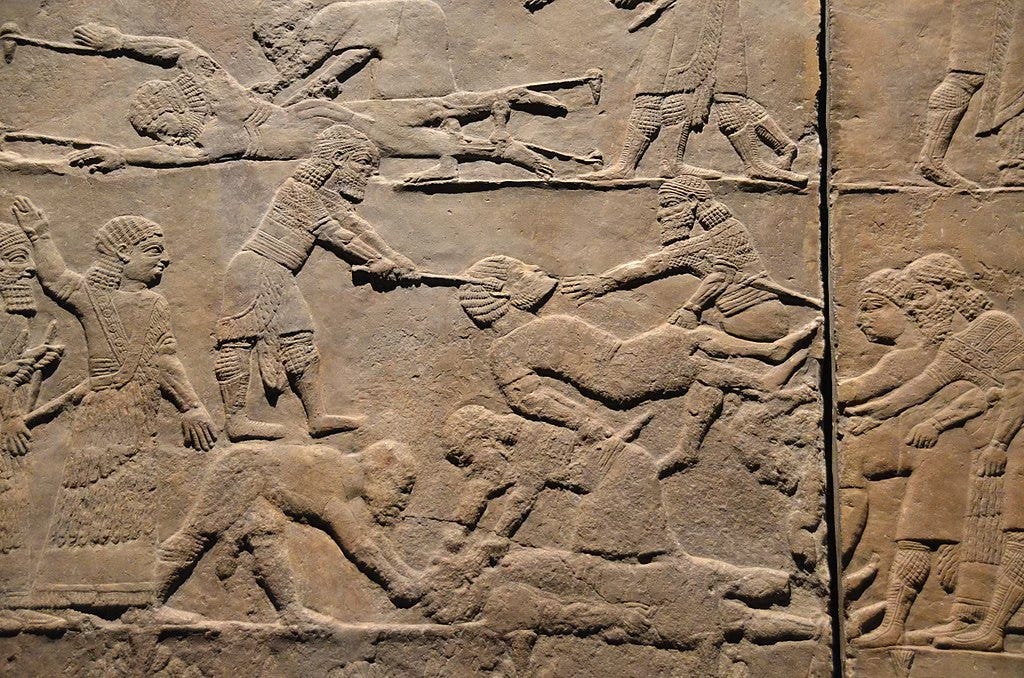
The removal of violence goes beyond just violent deaths. The US national violent crime rate has declined by over half since its peak in 1991, and the rate of nonlethal victimization continues to fall in similar fashion.2 Even mundane or low-level violence has dropped in recent years, with the rate of schoolyard fights halving alongside violent crime.3 Contact sports, despite their popularity in media, have declined in actual participation.4 In the 1980s, nearly ten percent of the population hunted, a number which today sits below five percent.5 While the cultural image of violence remains prominent, every actual measurement of violence shows a decline in its actual occurrence. Fewer people strike in anger, or receive such a strike, than ever before.
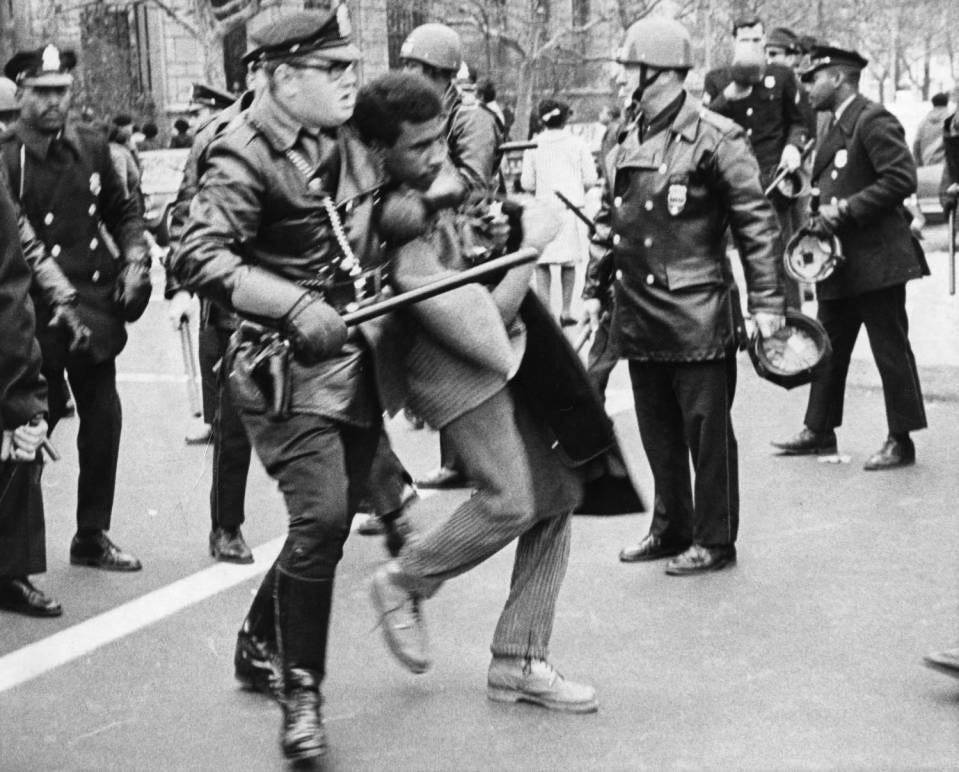
The violence that does happen is of an increasingly abstracted sort. The police no longer use batons to beat down criminals, instead opting for verbal de-escalation, jiujitsu, and less-than-lethal weapons with a softer public image. Tasers, pepper spray, etc. are now his primary tools, employed according to doctrine. This shift represents both an abstraction of the violent act, and of the policeman’s agency. The officer is given less discretion in his actions, reduced ever more to bureaucratic automata; his use of force is abstracted further by the use of something aesthetically distanced from the raw violence of a billy club or fist.
The language surrounding military violence has undergone a similar transformation. An enemy is not killed, he is “eliminated” or “neutralized.” The operation to kill him is not a hit or even an assassination, but “wet work,” “kinetic action.” A prisoner does not undergo torture, but “enhanced interrogation.” Bombing runs become “precision strikes;” the bombs themselves become “munitions.” Even the soldier is euphemized as a “servicemember” or “operator,” and his role is defined more nebulously than ever before—such that the Marine Corps mantra to “locate, close with, and destroy the enemy” feels almost archaic. This shift is more than just euphemism, as the US military’s tooth-to-tail ratio has moved constantly toward the latter since the Gulf War. Thus the average soldier is ever more unlikely to even deal with combat in his job, much less experience it.
These explicit shifts are only a small part of our cultural alienation from violence, and from pain. The language, tone, and framings we use to think about violence are historically unique, and only become more absurd by the day: we hide it, distance ourselves from it, fear it, obsess over it, redefine it over and over, and—like sex—sublimate it into semiotics.

Primary among these shifts is the simple fact that once-accepted forms of physical violence have become taboo. The schoolyard fight was once an American rite of passage among boys: a standard part of growing up, never precisely condoned by authority, but always expected to occur. Alongside sports, these fights have traditionally offered boys and young men an informal ritual reckoning with physical force, hierarchy, and self-confidence. Today, this is not the case. Outside of chaotic inner-city schools, fights are uncommon and harshly punished. Zero-tolerance policies, whether as policy or an implicit norm, mandate suspension or expulsion for both parties in a fight. These bureaucratic punishments take the form of surrogate violence, done against the subject’s future self: their “permanent record” will, as students are constantly reminded, affect their applications to college and thus the trajectory of their lives. This wreaks havoc on the psyches of high school boys, particularly those with the potential for a white-collar or high-powered job. Further, self-defense is famously not an excuse—both ending the fight as a rite of passage in gaining self-confidence, and enforcing population-level learned helplessness.
That these policies affect a student with potential far more than one without is by design, and particularly harmful. It guarantees that more or less our entire professional-managerial class will have learned total helplessness in the face of violence, and that the members of this group will be affected by some degree of lifelong future-anxiety. Foucault argued that observation was a primary mode of modern punishment; above and beyond observation is the continuity of observation, which allows no forgiveness or transience in identity, and ultimately crushes any sort of vital, youthful spirit. Paired with an increasing need for specialization in youth—from one’s professional track to even athletics—the incentivized form of life for the people destined to rule and build is one of constant and extreme planning for the future. One’s entire life is placed in their hands at perhaps thirteen years of age—and not in the historical sense that might send a midshipman to sea at that age. Instead, the individual is given the pressure without the responsibility, alongside the paralyzing refrain that any positive action also constitutes a narrowing of future possibilities. This incentive structure creates a population of highly-neurotic people, with very low risk tolerance. The bureaucratic safetyism6 that addresses youth violence is the same social structure that builds education around this outcome. Ultimately, this is the social structure that places a population of half-baked and cripplingly-anxious adults in charge of key institutions.

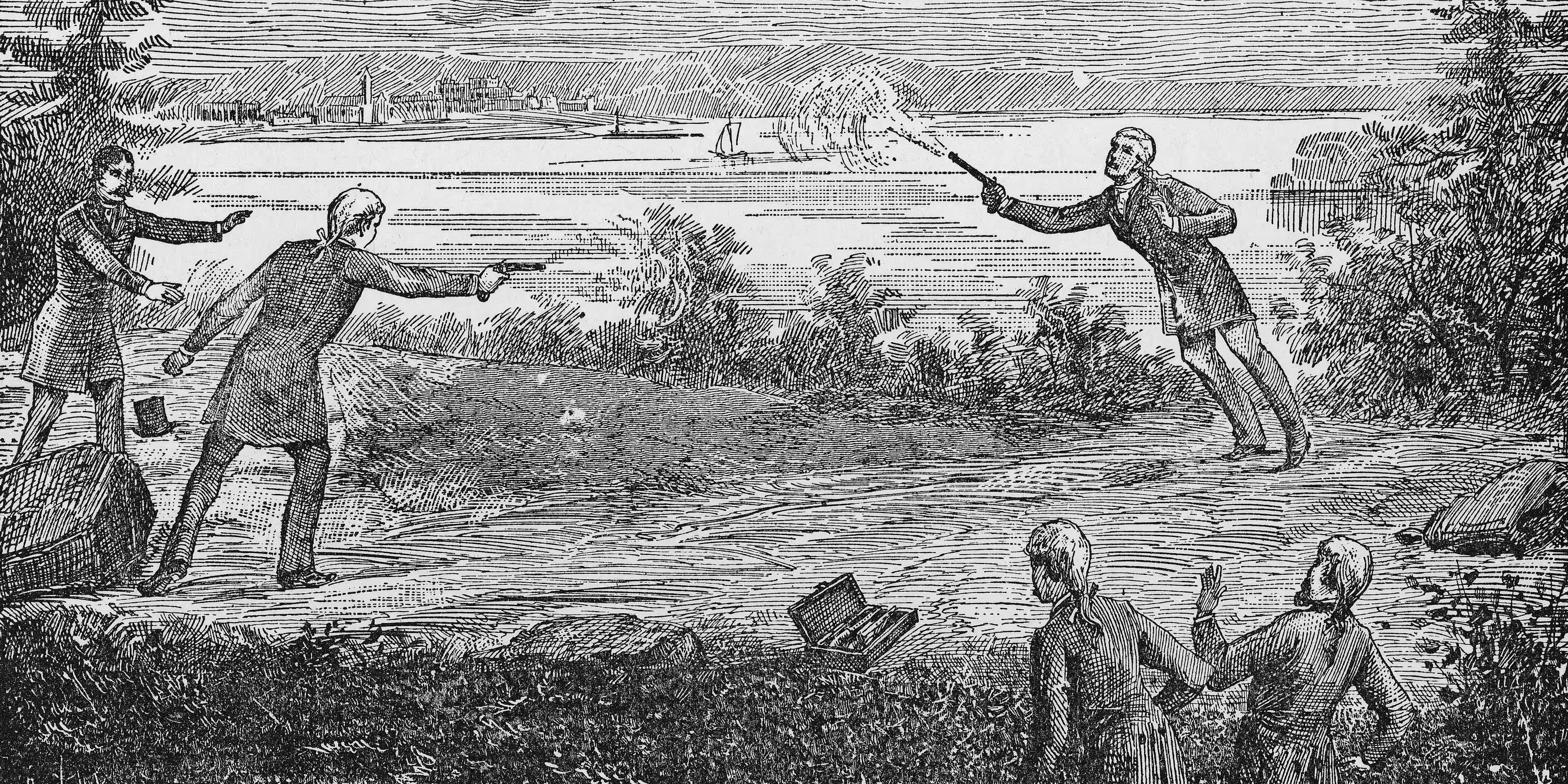
Once-normal violence is also suppressed in the adult world, creating similar forms of mass psychological detriment. Bar fights—again, never condoned but always expected, and often informally excused by the law—and similar low-level acts of violence are increasingly avoided due to the ever-present threats of recording and litigation or arrest. Like in the educational example, this suppression takes the form of anarcho-tyranny, applying mostly to the middle class and above; mild fights among the lower classes are more often than not ignored by authorities, and quickly forgotten by their participants. However, anyone who has something to lose—a family, any job above the menial, etc.—is forced to meet any insult or provocation with a calm and measured response. This culture shift has not resulted in fewer instances of provocation, but the opposite: verbal, social, and physical acts of provocation only increase when they go unpunished at scale. This suppression has created a new and universal humiliation ritual, applied almost exclusively to the median white man: walking away from a provocation that his grandfather would have met with force. This sort of ritualized sodomy only further beats the psyche into submission, teaching one to crush the part of his spirit that has always animated historical greatness. Would the American Revolution have occurred if not undertaken by the sort of men that met with pistols at dawn, or refused to polish a British soldier’s boots? At the very least, we would have been robbed of Hamilton, Burr, and Jackson—perhaps of the very spirit that animated the Declaration of Independence.
These psychocultural spirals are only part of the equation, but nonetheless help to illustrate our alienation from violence. Because violence is essential—that is to say, a core part of human nature and experience—our alienation from it results in stress and derangement. Cultural insanity begets personal insanity; that man becomes weak and soft is an effect of his emasculation.
It is worth noting that this alienation and emasculation is a continuous process, rather than a cultural change that can be pinpointed in time. Even as violence is extinguished to the best of our institutional and social ability, the mere concept of violence becomes the target—a process which continues even as the act itself is minimized. Just as the death of the fistfight causes conflict to manifest in a more feminine form (verbal, social, reputational), this form of conflict is also termed violent and suppressed. At this point the recent history of “words-as-violence” is well known: cancel culture, microaggressions, safe spaces, content warnings, and more have enshrined the concept in politics, media, and daily life. Nonsensically, this development of popular morality has resulted in the justification of actual violence in response to words-as-violence. The mid-2010s UC Berkeley riots against right-wing speakers stand out as an example, as well as the popular notion that use of a racial slur justifies murder. These actions are justified, at their core, as part of a sort of “war” against violence. The inherent contradiction only makes sense to people who have internalized that form of morality as a religious command.7
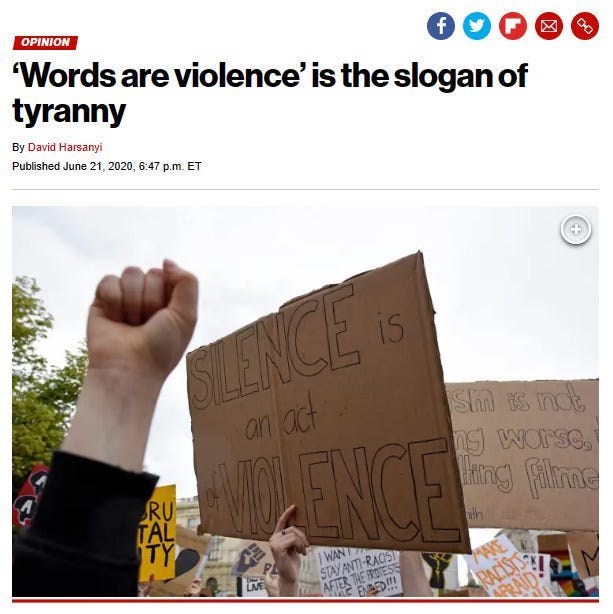
This cultural program of pacification-by-force produces a novel and bizarre view of violence-as-action. Instead of a volitional act, it now exists outside one’s set of possible actions. Violence is not something you do—it is only something that happens to you. For the vast majority of people, this simply serves to geld the thought that they might ever commit an act of violence.8 In the case of people who actually do commit violence—i.e. criminals—it reframes their actions as not their own, but products of “systemic factors.” Their agency is stripped and relocated to the semi-magical surround of social forces: “generational trauma,” “lack of community resources,” “cycles of harm.” The fact that most of them simply find it fun or easy is handwaved away as a pathology arising from these outside factors, rather than their own will.
Man, then, is redefined as a sort of vessel through which violence acts, rather than a being with moral or physical agency. Crucially, this framing allows only the protected racial underclass to be “possessed” by a will that is not their own; the rest are relegated to learned helplessness, and set at the mercy of the former. Every culture has placed a moral prohibition on wanton violence, but none until ours have attempted to sculpt a type of man incapable of imagining it. Such a man, structurally unable to entertain violence, cannot understand the best among his ancestors—nor wield anything close to their agency, decisiveness, and vitality.
II: Semiotics & Obsession
Despite our total alienation from violence, it remains essential to both the individual and society. “Force is,” as Heinlein said, “the supreme authority, from which all other authorities are derived.”9 Especially in a state and culture that exerts so much soft control over the individual, the fact must be remembered that violence sits at the bottom of the conceptual well.
Often, it is the uncomfortable reckoning with this fact that creates derangement and cognitive dissonance. Bearing witness to an act of violence-as-authority evokes fragility, even horror, in the popular mind. We are brought uncomfortably to Heinlein and Heraclitus10 each time there is a state execution, a war, or a highly-public police use of force. A pop-culture rending of garments and gnashing of teeth follows each event. That the Leviathan is ultimately and always a beast of violence does not mesh with a mass-religious commitment to destroying its substance.
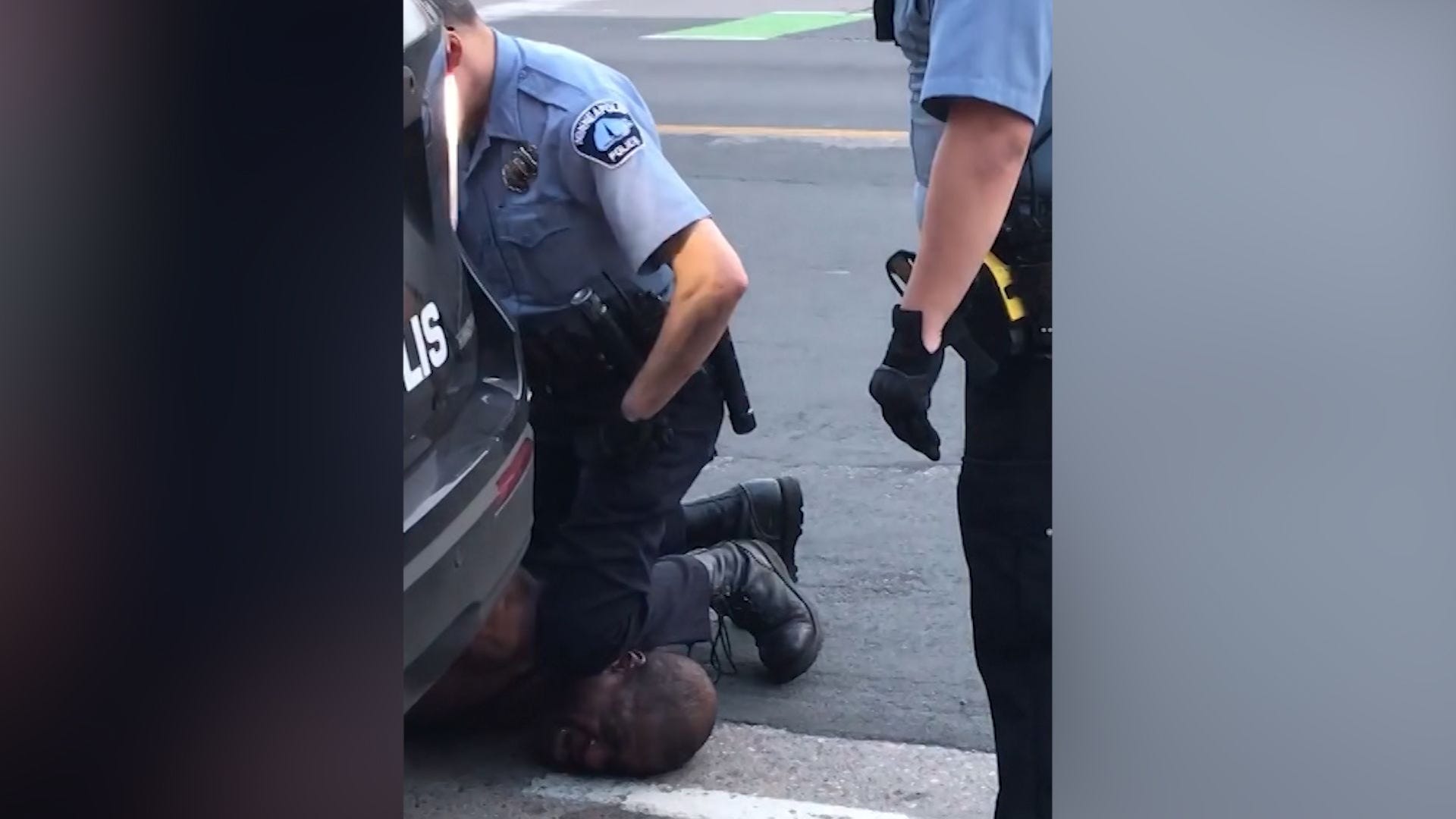
Because of the contradiction between our rejection of and immersion in violence, the thinking of Hobbes, Machiavelli, and Weber creates a dual sense of unease and revelation in the modern mind. Their study often leads to a transformation: a reactionary shift, a dedication to mastering violence, or simply an interest in war. Sometimes, through much less-intellectual paths, their core concepts lead to a radical and bizarre questioning of legitimacy—as seen in quasi-cultic groups like Sovereign Citizens, off-grid preppers, and anarchist “police abolition” movements. These groups are united by their fixation on the fangs of the Leviathan, and each enact their own sorts of rituals to ward off the beast. Ultimately, these rituals serve as shadow-plays of a broader cultural disjunction: acts of fantasy that echo our collective inability to reconcile with violence as necessary and central.
However, the primary result of this societal dissonance—and the one most visible in mass culture—is a pathological fixation on violence. This takes the form of constant “exertion” and “consumption” of it, in the only realm where it is permitted: the semiotic. Violence becomes symbolic, vicarious, and undertaken entirely through media.
That violence exists primarily on-screen is immediately obvious in the evolution of film and television. Today, action movies make up the bulk of the highest-grossing blockbusters, and perhaps even the majority of major motion picture releases overall. The fight scene—any action movie’s pièce de résistance—is as old as film itself. The fantastical, often comical fight scene of early silent films evolved into the theatrical period-piece showdowns of the 1950s, and later to the flashy age of both the Bond series and the kung fu flick. Later, the explosive action movies of the ‘80s and the experimental syntheses of the ‘90s have led to both the modern superhero-epic and the “gritty” action thriller, both of which are now assembly-line produced with little cultural impact.
Between the advancement of technology and technique, the modern fight scene has departed from its predecessors in both form and function. Today, a fight scene is more often than not “gritty:” it shows pain, damage, and intense effort. Contrast this to the early Bond films, or to Bruce Lee’s classics; these movies used the fight scene as an expression of skill and aesthetic value, departing from reality in order to create visual interest. The action sequences of the ‘80s—starring the likes of Chuck Norris, Arnold Schwarzenegger, and Sylvester Stallone—were, by contrast, pure power fantasy: men with statuesque physiques enacting explosive fury. This unselfconscious gaudiness is more often than not shunned today. Instead, our heroes are destructible and much farther in looks from the vision of Arno Breker. ‘90s films played heavily with the form of the genre, bringing us The Matrix and Blade as heavily-stylized, high-concept epics. It also saw the peak of the action-comedy blockbuster (Rush Hour, Bad Boys), riffing on the conventions of the action film as an institution. Today, neither experimental stylization nor parody are in vogue; action flicks, even superhero movies, are grounded firmly in our aesthetic reality, and few stabs are taken at the action-comedy format.
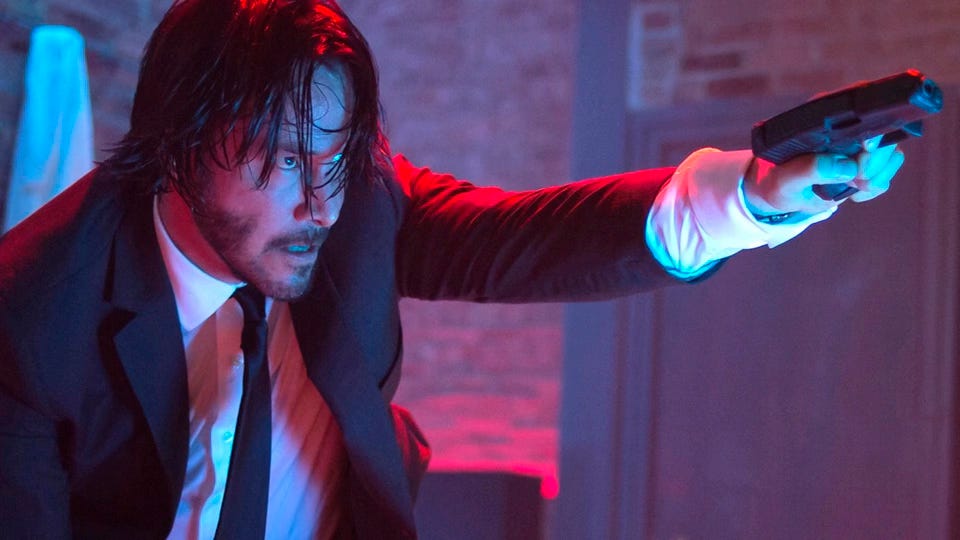
Instead, the modern action movie and fight scene have taken on a formulaic and unintuitive quality. Fight scenes are filmed closely, with large amounts of camera movement and hundreds of cuts; this creates a feeling of frantic participation by the viewer. Stylization, when present—as in the environments of John Wick—almost never interfaces with the actual violence, which despite its lavishness stays as grounded as possible to logical reality. Wick uses UFC-style jiujitsu, and contra Rambo or John McClane, is strictly limited by the size of his firearms’ magazines. Even if the overall film is absurd, cues like this tell the viewer that its violence is “real” in a meaningful sense. Bringing these aspects together is the constant hunt for “grittiness,” within the constraints of an average viewer’s stomach. The hero is able to be injured, and feels tired from the exertion; he and his opponents feel pain and show it.
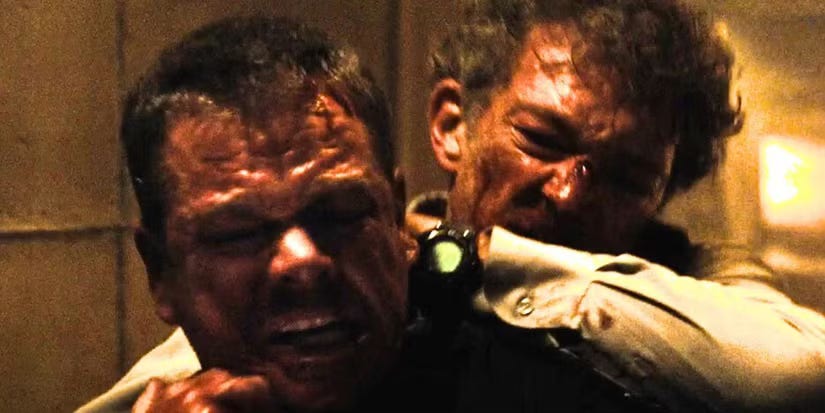
Ultimately, the consistent format of these fight scenes serves a purpose: the simulation of violence. The viewer watches the film not to be dazzled with visual flair, nor to see elegant skill—he watches it to go through the motions of combat himself, to experience the rush and pain. The participatory format of the fight scene has been the technical achievement that underlies all depictions of violence today, and thus the mass-cultural experience of it. The Violent Passion Surrogate of Brave New World—“all the tonic effects of murdering Desdemona and being murdered by Othello, without any of the inconveniences”—has come to fruition in the campy action sequences of Kingsman (2014) and The Beekeeper (2024).11
Taking these films as examples, the fact that both are utterly cartoonish and ideological is another key aspect of their function. As the experience of violence in the average person’s life trends increasingly toward simulation, it is integrated—by popular demand—with attacks on popular targets. The viewer of Kingsman is offered not only violence, but an orgy of blood unleashed upon a stand-in for the despised Westboro Baptist Church. The viewer of The Beekeeper experiences the rush of crushing the skull of a reviled “tech bro” underfoot. The villains of today’s action movies—near-universally white men, often intolerant in some way—are ritually sacrificed at the hands of the viewer, over and over, in increasingly absurd ways.12 It is particularly telling that these “approved” scenes of violence are used endlessly as political “dunks” on social media, by which a user (and their audience) enjoys violence against the opposition from their designated corner chair.
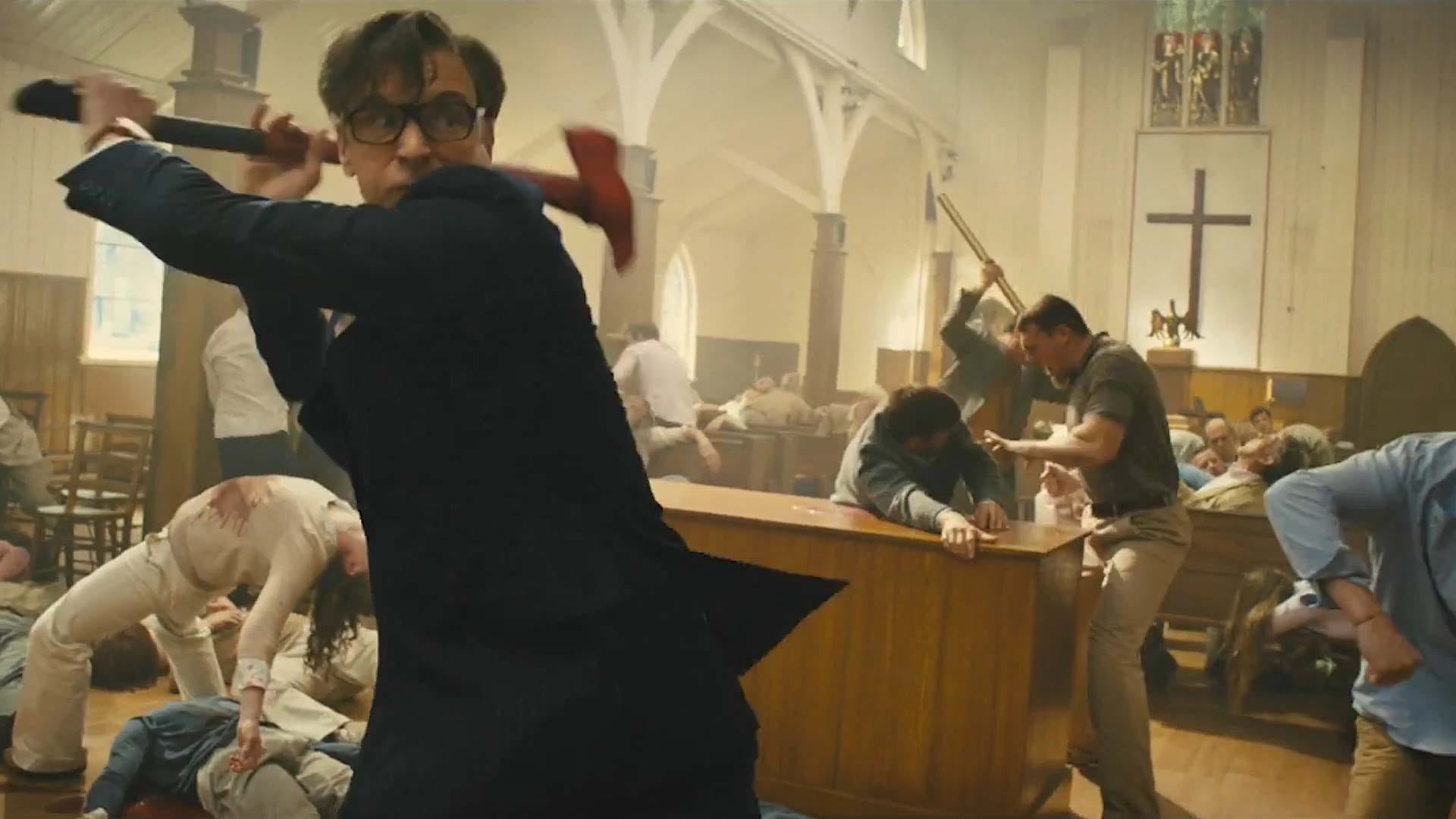
Denied the right to strike anyone in physical reality, the viewer is allowed to enact semiotic violence against approved targets only through his consumption of media products. The violent instinct is in this way directed toward culturally-approved forms and targets. Here, Aristotelian catharsis finds its inverse: some steam is let off, but ultimately the violent instinct is cultivated by simulated repetition, such that it can function only in the symbolic plane and toward “proper” quarries.
Film, however, is only one example. The export of violence to the semiotic plane extends far beyond media. Real acts of violence, when they do occur, are rapidly converted into political tulpas—ritual objects for discourse and repetition—until they cease to feel real at all. Events like 9/11 become an infinite well of comedy material; acts of terrorism are collapsed into memes, repurposed into political shorthand, or mythologized outright.13
The line between real and fictional violence quickly blurs, as the latter is mistaken for the former in the collective consciousness. Fictional threats like sundown towns, frat-boy rape-gangs, gay bashing, parking lot abductions by sex-traffickers, and drugs in Halloween candy exist more prominently in popular thought than actual threats. The very concept of violence is made increasingly fantastical, unreal, and absurd with each passing day. To carry a gun in case of armed robbery is seen as a bit much, but to check under your car for an Achilles heel-slicing maniac is not uncommon.
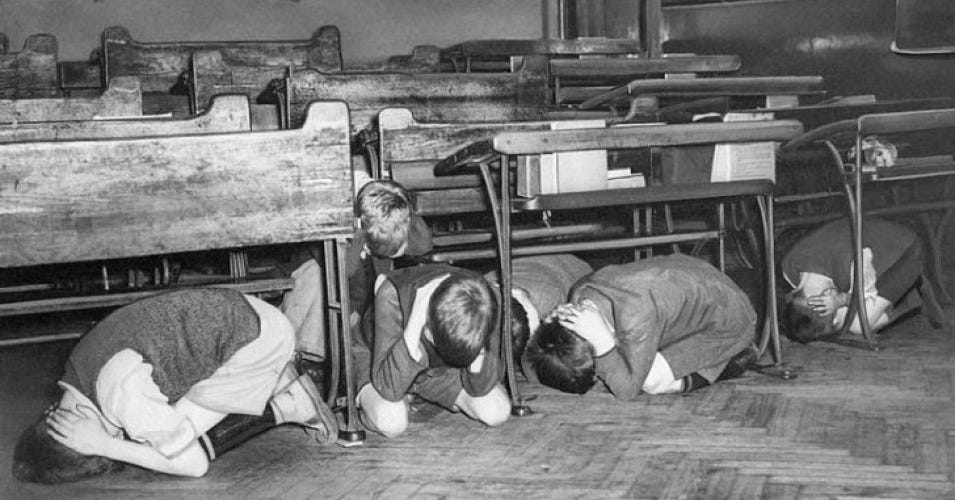
The fear of violence is further reinforced by ritual reenactments of its prevention. During the earlier years of the Cold War, American schools used “duck and cover” drills to prepare for nuclear attack; of dubious necessity, these drills did far more to reinforce the very existence of the Cold War—an intangible thing by nature—than they ever did for civil defense.14 Today, the same effect is achieved with active shooter drills. Unlike duck-and-cover, which might plausibly save lives in specific scenarios, active shooter drills offer little measurable benefit beyond the ritual infusion of psychological terror.15 These events, ranging from huddled vigils in a dark classroom to full-on simulations with gunshot sounds and “masked gunmen,” serve to vividly reinforce the ground reality of school shootings, implanting them as a generational anxiety far beyond what media already achieves. Just as the threat of nuclear apocalypse numbed and stressed the Cold War generations, a terror of school shootings afflicts today’s youth.
Again we see violence turned into a symbolic, entirely-psychological event experienced by the masses via simulation. Like action movies and social media hoaxes, school shooting drills are instantly materialized as political beliefs. In this sense, the primary function of these rituals is ideological, as well as fear-inducing. The overall effect creates a culture which is at once completely alienated from violence, yet hopelessly obsessed with it in its symbols and thought.
III: Progress
Human society has in recent years reduced violence across all metrics. But does this truly represent progress? Fewer people suffer at the hands of another, and fewer are sacrificed on the altar of mass warfare—but are we actually less violent, if that is the goal? Even a brief survey of American culture shows this not to be the case. We may kill and die at a lower rate, but “progress” has not succeeded in removing violence from the human condition, or even in dampening its role in society. Instead, it appears that we remain obsessed with violence, and moreover experience distress from its suppression—really, its redirection. Marshall McLuhan:
“The fact that pain is a sensation that ‘can even survive the disappearance of the initial source’ is of the utmost significance to the student of media. This fact points to the central nervous system itself as a key factor in pain, and helps to explain why institutions and technologies which have long been amputated from the social scene can continue to inflict corporate misery.”16
Pain is still inflicted today, and violence still occurs. In the absence of physical pain and violence, the sort inflicted today takes place on the semiotic plane. In all cases, this sort of violence deals mass-psychological harm. The suppression of low-stakes, constructive violence selects for spinelessness and emasculation in leadership. The cloaking of state violence creates mass derangement, bordering at times on psychosis.17 The removal of agency in violent acts lets criminality run amok, and allows for a bizarre neomorality that justifies “violence against violence,” in turn threatening free speech.18 The libidinal exercise of violence through media—a sort of Two Minutes Hate that lets the viewer feel the subject’s windpipe beneath his boot—allows the media an even deeper ability to propagandize at will. And, despite the actual reduction in violence, a mass fixation on faux-threats induces chronic anxiety, negating any psychological benefits gained from the real reduction in bloodshed.
If the removal of violence actually constituted an amputation, its phantom pains would be felt in these forms of popular insanity. But as long as man has hands that can be formed into fists, front-facing eyes that track movement, and shoulders meant for throwing, violence cannot be amputated from his condition. The very fact that man can feel pain shows him to be a creature of violence: he is a predator, an agentic actor, a social and territorial creature. Until mankind is reduced to the status of a mussel or hive-insect, violence will be a part of his nature.
Our recent alienation from violence cannot stand as a permanent state; at most it can be a temporary lull, a pressurization of the Will until it bursts forth in grand fashion. How long can the “suburbs dream of violence” until that dream burns down their drowsy villas and benevolent shopping malls?19
The vast project that constitutes our alienation from violence is not an inevitable one, nor the only possible outcome of a society which has become more effective at maintaining order. Anarchy, overthrow, or revolution are not the inevitable answer—but they threaten to become the only answer, if we do not reckon with the essential nature of pain and violence.
On Violence is an essay from my new book, Schizoposting. If you’d like a print copy, you can buy it on Amazon. The entire thing is also free as a PDF.
Chapter 1 and 2 in Better Angels (“The Pacification Process” and “The Civilizing Process”) cover this analysis, which is also cited in the work’s introduction. The number for the modern US is drawn from the CDC’s National Vital Statistics System (2022 numbers), and includes war deaths, which are discussed on pg. 680 of Pinker.
Statistics from the FBI and Council on Criminal Justice.
CDC, National Youth Risk Behavior Survey, 1991-2019.
Johnathan Macy et al., 2021. “Fewer US Adolescents Playing Football…”
See Wildlife For All, “The Decline of Hunting and Fishing,” for a summary of U.S. Fish and Wildlife Service and state-level data analyses.
This term was coined by Lukianoff and Haidt in The Coddling of the American Mind (2018). However, it is used here in a much broader sense, i.e. as a pathological orientation toward minimizing risk of any sort.
This concept is more in-line with the critiques of safetyism in The Coddling of the American Mind, which describes it as “a sacred value.”
The criticisms of On Sex can also be seen as the results of this moral framing when sex is seen as violence.
From Starship Troopers. That Heinlein wrote the book in a frenzy of rage against nuclear disarmament should be a key to its interpretation, and yet…
Fragment 53: “War is the father of all and the king of all; and some he has made gods and some men, some bond and some free.”
The latter is a strong candidate for the worst movie ever made.
See also “White Men are Stupid in Commercials,” for the same process but with mockery and humiliation.
See Ted Kaczynski, “Killdozer,” and the mass shooter Patrick Crusius, who was near-instantly turned into a meme.
Oakes, Guy. The Imaginary War: Civil Defense and Cold War Culture (1994)
Everytown Research & Policy, “The Impact of Active Shooter Drills in Schools: Time to Rethink Reactive School Safety Strategies.” This report covers the impact of active shooter drills, demonstrating them to be of dubious effectiveness and extremely psychologically harmful to students of all ages.
War and Peace in the Global Village (1968), with Quentin Fiore.
To see this psychosis, one only needs to look at the 2020 Floyd riots.
Ibid.
J.G. Ballard, Kingdom Come (2006): “The suburbs dream of violence. Asleep in their drowsy villas, sheltered by benevolent shopping malls, they wait patiently for the nightmares that will wake them into a more passionate world.”
Reminds me of a quote from Spengler’s Hour of Decision:
“Man is a beast of prey. I shall say it again and again. All the would-be moralists and social-ethics people who claim or hope to be ‘beyond all that’ are only beasts of prey with their teeth broken, who hate others on account of the attacks which they themselves are wise enough to avoid. Only look at them. They are too weak to read a book on war, but they herd together in the street to see an accident, letting the blood and the screams play on their nerves. And if even that is too much for them, they enjoy it on the film and in the illustrated papers. If I call man a beast of prey, which do I insult: man or beast? For remember, the larger beasts of prey are noble creatures, perfect of their kind, and without the hypocrisy of human moral due to weakness.”
💎