Discourse as ARG
From "Schizoposting," Part II

“The computer abolishes the human past by making it entirely present. It makes natural and necessary a dialogue among cultures which is as intimate as private speech, yet dispensing entirely with speech. While bemoaning the decline of literacy and the obsolescence of the book, the literati have typically ignored the imminence of the decline in speech itself. The individual word, as a store of information and feeling, is already yielding to macroscopic gesticulation.”
McLuhan, War and Peace in the Global Village
I: Definitions & Parallels
An Alternate Reality Game (ARG) is “a type of multimedia game for multiple players that takes place in real time and evolves according to decisions taken by the player rather than by a programmer.”1 Often used in marketing, the core sell of a good ARG is a convincing, hidden world layered atop physical and digital space, which the player can not only investigate but influence. Together, the collective of players is able to direct the form and outcome of the game-world, which does not “progress” (or even meaningfully exist) without their participation. An ARG’s “world” is the truest form of a virtual environment, in that it suspends a simulated reality which you can reach out and touch without any special technology. Because the ARG manifests solely between the mindspace of its players, it can also be described as an egregore; if no one plays the game, its world “dies in place” and effectively ceases to exist.
Aside from this esoteric definition, some simple background: ARGs are by-definition multimedia phenomena, traditionally taking the form of a mystery. Some famous examples include Cicada 3301, “I Love Bees,” marketing for The Blair Witch Project, and Shia LaBeouf’s “He Will Not Divide Us.” All of these leveraged online interconnectivity and physical, real-world engagement to drive players through a participatory, progressive game that leverages some degree of unreality in its internal structure. While the common connotation is marketing (Blair Witch, “I Love Bees”), the goals of an ARG can be wildly divergent: Cicada 3301 used cryptographic puzzles and physical posters in major cities to “vet” players for initiation into a still-mysterious group, and “He Will Not Divide Us” began as an emergent, unplanned ARG among those who wished to annoy its creator. Some further examples: the University of Southern California has used an ARG (“Reality Ends Here”) for freshman education since 2011; the 2007 ARG “World Without Oil” was used for environmental activism; and Disney World Orlando includes multiple ARGs to encourage deeper engagement with, and thus spending in, its parks. The concept is multipurpose, and the ARG dynamic serves as a broad descriptive frame.
Along with virtual and mixed reality games, the ARG has been a subject of fascination by the military-industrial complex for some time. ARGs are capable of mobilizing hundreds or thousands of people in physical space (see “Why So Serious?”)—including those with high-level cryptography and OSINT skills, as in the case of Cicada 3301.2 The medium has also been used for large-scale data collection: the vast location and camera data troves of Pokémon Go3 were used by Niantic for years to train a “large geospatial model”—a granular map of millions of locations, meant to achieve “spatial intelligence.”4 Both as a centralized media product and as a phenomenon that creates emergent mass coordination, the ARG is a useful model and tool for interfacing with a wide array internet-mediated social dynamics, a key element of fifth-generation warfare—hence the Pentagon’s interest.
However, the ARG concept applies to far more than one-off marketing stunts, trolling campaigns, or organized recruitment efforts. The entire online environment—or battlespace—can be conceptualized as a vast ARG. In a sense, social media is the supreme ARG: online, emergent team-based conflicts determine acceptable political beliefs, personal behavior, corporate and institutional actions, self-conceptions, and ultimately perceptions.5
The alternate-reality aspect of Discourse comes from the fact that social media relies on a virtual environment, both literally and figuratively. Of course, Instagram, TikTok, X, etc. do not physically exist; these platforms are maintained as a layer atop reality (or beneath it, depending on your perspective). But this extends figuratively, in the sense that there are “online-only” debates, perceptions, and egregores. The 2014 Revolution relied on the construction of one such virtual environment, in which gendered violence was a rising crisis of utmost importance in physical, mass-experiential reality. The folding-in of traditional media to this internet-mediated ARG has only served to totalize it, in the sense that you can “exit” the real world and “enter” the virtual through an ever-increasing number of media products and even physical spaces.
The gamification of Discourse is two-pronged as well. On one level, platforms gamify the user experience, turning engagement with their app into an addictive Skinner Box, atop the already-present reinforcement methods inherent to social media.6 Further, and more directly, engagement with social media discourse in the realm of politics and culture often takes the form of a literal game. Repost chains, harassment campaigns, sharing “pictures [a given public figure] doesn’t want you to see,” etc. are participatory actions meant to progress, realize, or solve the game; without mass player engagement, this “progression” does not happen.
In this framework, the entirety of the “cancel culture” phenomenon can be framed as part of this novel Discourse ARG. A dispersed network of quasi-anonymous players performed political praxis by contacting employers, universities, and news agencies in coordinated harassment campaigns to enforce online social norms in physical reality. This enforcement of the alternate world on physical reality is the key defining aspect of the Discourse ARG: sub-games (or levels) are “solved” each time ideas from Discourse are enforced (or otherwise bleed into) mass physical reality. This aspect has been called many things: meme warfare, community organization or action, decentralized propaganda, etc.
Critically, participation in this ARG is an esoteric, even occult, action. Both high-level analysts and basic participants trend toward looking at the online battlespace as akin to Plato’s realm of Forms, in which sorcerers (users) can shift aspects of reality by interacting solely with those Forms.7 Social media formalizes this relationship by manifesting that theoretical, esoteric realm “vulgarly”—i.e. in a fashion physically accessible to billions of people. The user-conception of social media as a magickal substrate and its subsequent reality-shaping effects are best described by Egil Asprem’s The Magical Theory of Politics, which describes the “magic war” over the 2016 Election. Its critical meta-insight is that whether or not terms like “sorcerers” or “mages” are accurate—insofar as they imply something supernatural is happening8—is immaterial. These terms are simply useful to describe the rules and actions involved in the Discourse ARG. In fact, the magickal terminology only serves to reinforce the alternate-world aspect of it, in that extensive engagement with the Discourse ARG produces language seen by most as schizophrenic, even if it accurately describes the forces at play and their indirect-but-powerful influence on reality.
The reality-shaping goal of the Discourse ARG defines it in opposition to the original all-encompassing ARG: the market. Even a vague familiarity with Wall Street shows it to be alternate on a basic level, with outsiders seeing its spasms as nonsensical actions that only make sense within some sort of dream-logic. On a basic level, Baudrillard pointed out the unreal nature of the investment world, alienated from production, in The Transparency of Evil:
There is something much more shattering than inflation, however, and that is the mass of floating money whirling about the Earth in an orbital rondo. Money is now the only genuine artificial satellite. A pure artifact, it enjoys a truly astral mobility; and it is instantaneously convertible. Money has now found its proper place, a place far more wondrous than the stock exchange: the orbit in which it rises and sets like some artificial sun… Speculation is not surplus-value, it is a sort of ecstasy of value, utterly detached from production and its real conditions: a pure, empty form, the purged form of value operating on nothing but its own revolving motion, its own orbital circulation.9
He goes on to liken the gamified aspects of the stock market to poker, in which betting and bluffing between players is the basic financialized “game;” this is a generally-useful assessment. Thus in the market we have a real-time, multimedia, mass-participatory game that leverages some sort of “alternate world” and only progresses via the actions of its players: the original and longest-running ARG in human history.
But the market’s meta-ARG is fundamentally opposite to the Discourse ARG, in both form and function. Since 1773, the stock market has operated on the same basic concepts, centered around a variety of reality-reinforcing principles. Effective investments are made by having a better comprehension of reality than the rest of the game’s players: present and future demand, supply chain dynamics, management and employee quality, etc. Insofar as stocks and other commodities (even complex derivatives) are simulacra, their basic alignment with reality is reinforced on a regular basis via financial reports. No matter how complex the financialized commodity, it ultimately must represent some sort of underlying real value. This alignment with reality is reinforced by the nature of stock trading: the most basic source of value in a stock investment is an under- or overvaluation. A gap between stock price and intrinsic value represents a misalignment from reality, and investors are rewarded for finding and exploiting these situations. Thus, the increasingly-rapid quant-trading system serves as a sub-game that rewards players for constantly reinforcing the stock market’s alignment with reality.
Of course, this system is far from perfect; if it perfectly interfaced with reality (or even hypothetically could), there would soon be no value in financial services, and the entire economic system of free-market capitalism would be automated in moments.10 It is also important to note that the market can at times spin completely away from reality due to some sort of broken piece of logic in it, or due to corruption: speculative bubbles and various other forms of financial crises serve as examples. However, this does not negate the fundamental nature of the thing, since it is the reality-reinforcement principle that ultimately “pops” these bubbles—from Dutch “tulip mania” in 1637 to the 2008 financial crisis. At some point, tulips must demonstrate intrinsic value; at some point, somebody has to pay up for overleveraged subprime mortgages. If that doesn’t happen in real-time, the market will eventually realign in catastrophic fashion—driven in part by savvy investors exploiting the gap between representation and reality for profit.
Thus the stock market is incapable of shaping reality by nature. It can temporarily misrepresent what is real, but it cannot alter it. Its dominance as the primary societal ARG is waning in comparison to the dominance of the ARG that can (and by nature does) change that base reality. The cynical refrain of “it’s priced in”11 is replaced by the revolutionary call to overturn, invert, and reform; war of all against all for the exercise of some sort of agency.
There is also a critical difference between the aspect of reality interfaced with by these ARGs. The “data layer” of the stock market, through which its games interface with the real economy, is exclusively numerical; it has to reckon ultimately with quantities of dollars, hypothecated or otherwise. This is a broader element of the reality-reinforcing principle, with its inverse found in the Discourse ARG, whose data layer is composed of the messy attempt of Big Data to quantize the entirety of qualitative human consciousness.
More concretely, stock market data can be used to recreate a convincing simulated market (including the most complex types of derivatives), whereas social media data can only simulate a poor imitation of a human mind. The LLMs produced by this data decohere into hallucination and schizophrenia when faced with simple queries—which seems to be an inherent, rather than fixable phenomenon.12 Even the most advanced models seem incapable of meaningfully imitating human social interaction, and are quickly identified as bots when used in social media campaigns.
II: The Discourse ARG in Practice
“As postmodern culture crosses to hypermania and goes nova, it singularizes multiplicities of invasively autoreplicating plexoweapon-systems that are nothing beyond their war against security. This is no longer a question of ideological representation, exogenous political mobilization, theoretical critique, or strategic orientation, but of decentralized cultural diagrams functioning as immanent forces of antagonism. K-war derives its sole coherence from the unity of its foe.”
Nick Land, Fanged Noumena
The Discourse ARG was loosely defined in the preceding section. This section aims to model out the ARG in its current state by examining its gameplay, structure, history, cultural outgrowths, and various aspects of its “meta.” So far, niche examples have been used to describe simple aspects of gameplay: repost chains, cancel culture, meme warfare, etc. These phenomena are simple versions of the full picture, and easily identifiable as ARG engagement in that they clearly resemble a sort of turn-based game. However, gamification occurs on a much broader level, beginning with the separation of all aspects of Discourse into team-based phenomena.
In electoral politics, the radical divergence of priors between the Left and Right has spawned two entirely opposed worldviews. The “moderate” or “swing voter” has rapidly become a relic of the past, a slippery (and practically imaginary) figure that is invoked mainly to wishcast for either side. “Bipartisan initiatives” are a sham in this new paradigm, as the gratification of one side requires the immiseration of the other. The common-goal-oriented politics of West Wing read even more as absurdist fiction than they did in the early 2000s; Sorkin’s fictional world of cooperative, merit-based, bureaucratically-constructed policy is now only invoked to support one side or the other’s exclusive aims.
But this bifurcation occurs everywhere, and while Discourse is inextricable from mainstream politics, the world of elections and policies is only a subset thereof. The full picture of the Discourse ARG encompasses everything from Presidential elections to popular movies, dating norms, aesthetic preferences, language, career advice, and more.
Broadly, the four most Discourse-loaded subjects are politics, sex, violence, and media. All aspects of Discourse fall into one or more of these pathways, and the teams are formed around their views on these four pillars. If you only know someone’s interpretation of Starship Troopers (1997), you can derive with startling accuracy their beliefs on dating and marriage, police use of force, American history, religion, and tax policy—or vice versa.
This is not solely due to the fact that personal philosophies tend to trend one way or another, and is more ascribable to the team-based nature of the Discourse ARG. To continue with the example of Starship Troopers: beginning in 2023, this 26-year-old film joined the legion of somewhat-silly media products revived as battleground concepts and near-instantly transformed into tribal shibboleths. Prior to that revival, its interpretations were diverse and often unserious; however, once it became a battleground concept, the interpretations speciated into two well-defined views, which now do seemingly-endless battle on social media.
The debate over Verhoeven’s “satire” is only one small instance of the polarization that defines Discourse, and thus American political life. Thousands of similar examples have cemented various media properties, tropes, political debates, memes, and standards of personal behavior as tribal emblems. The overall meta-shift is toward politics as fandom—in which the primary goal is not to hash out policy changes, philosophies, or candidates, but to become better-versed in one’s group shibboleths in order to push against those of the opposing group. Seven or eight murky steps downstream of this process is actual power politics—hence Asprem’s esoteric, Neoplatonic framing of Discourse—but the core in-game action is to collect the right products, ideas, and aesthetic preferences through engagement with the ARG. Thus politics and philosophy are reinvented as fandom, distinct from its various cults of personality; sex and violence as trope-mediated acts of fanart; and media constructed in reverse, akin to fanfiction, in order to appeal to (or, more often than not, attack13) a tulpafied fanbase of certain properties and tropes.14
As a result, every single conversation becomes an iteration of the same grand conversation: a singular instance of the Discourse ARG, a skirmish determining tribal claims to a piece of noetic territory. These conversations necessarily take place in a virtual environment, a cybernetic pocket universe in which analysis of children’s television translates to political power (i.e. force) wielded against members of the opposing team.
What makes the ARG enticing is that it actually does work in this manner: niche debates determine the acceptable range of public discourse and behavior, punish the winning side’s enemies (via firing, social estrangement, or violence), and inform the creation of future media. When culture and politics are downstream of social media, the Internet is real life—and ARG gameplay, no matter how absurd, is effective praxis. Thus, the level of vitriol normally reserved for blood-and-soil conflicts (or at least extreme political disputes) dominates conversations about things as nominally-mundane as videogame character design.
Whether the complex mechanics behind this are understood by players is, per Asprem once again, immaterial to practical interaction with them. In fact, reflexive and non-introspective engagement with the Discourse ARG is encouraged by the algorithms of most social networks, as it is this libidinal interaction that produces the most time spent in-game and thus the most user data. In this field, rage is the most profitable emotion.
The consolidation of fandoms15 and skirmishing over cultural territory described above form the two main bases of ARG gameplay. However, the concept can be extended much further. Just as in athletics, e-sports, mixed martial arts, or any type of competition, gameplay iterated over time creates a “meta:” the Most Effective Tactics Available at a given moment, or the game-above-the-game played at its bleeding edge of competition.
The development of a “meta” is most visible in an analogy brought up earlier, in On Men and Women (II: Effects). Regarding personal behavior, the Discourse ARG functions as a vast legal system, ruling on new cases each day. An infinite stream of pictures, videos, screenshots, and resulting “takes” forms the caselaw basis of neo-etiquette and neomorality, with the online collective able to dole out collective shame to the losing party. This “meta” passed far beyond simple legalisms like “double texting” or “age gap relationships” years ago, and now rules on increasingly-granular aspects of personal conduct, down to vocal inflections and facial microexpressions. Each “ruling” brings the crushing scorn of millions directly to the losing party’s mental doorstep, and suicide is not an uncommon outcome.
The sheer scale of social shame able to be leveraged against people for micro-sins—things as small a cringeworthy joke, a bad fashion choice, or misguided flirting—is greater than that of the largest and most bloodthirsty crowds of the French Revolution. Additionally, the team-based aspect of Discourse guarantees that even the “winning” party (per the court of public opinion) will receive significant shame as well. The process is the punishment, and the medium is the message; even if only a microscopic fraction of people are made subjects of Discourse, the severity of the punishment is enough for the framing to be adopted en masse.
The viciousness and totality of this arrangement—due to de facto constant surveillance—creates the “meta” of acceptable social behavior. If the Overton Window defines the bounds of acceptable political discourse, then this is the Overton Keyhole: a vanishingly small aperture of “permitted” behavior, chased constantly in order to avoid the boundless cruelty that is becoming the center of Discourse for even a moment. This phenomenon was already becoming inescapable in 2014, as traditional and social media morphed into a single, interactive propaganda apparatus. However, it was imposed permanently in 2018,16 as the use case of any iPhone-type device changed from “the place where your apps are” to a dispenser of infinite shortform video. Since then the personal-behavior “meta” has become not only emergent but imposed—understanding it has been made unavoidable.
Aside from personal behavior, the concept of a “meta” also defines how quickly concepts are made into shorthand and integrated as shibboleths among each team. The debate over Starship Troopers, for example, has spawned numerous shorthand attack-memes, and the film’s imagery has been overlaid into broader political discourse since 2023. The speed at which subjects of debate are folded into the language and symbology of ARG teams is essentially the governing speed of Discourse: physics has c as its maximum speed, and Discourse has the speed of meta development as its minimum.
The rapidity with which the meta iterates and develops helps in identifying artificial “movements” and ideologies. Generally, a group which engages in Discourse but does not keep up with the pace of the meta can be considered fake by default; it lacks the interactive, back-and-forth creativity that defines ARG participation. A simple example can be found in the Ukraine War-related group “NAFO,” which billed itself as an organic pro-NATO movement but actually consisted near-entirely of US military and government employees posting repetitive memes and talking points from Eglin Air Force Base.17 When rhetoric and in-group symbols remain absolutely consistent, rather than updating to the game’s currently maximally-effective tactics, it is likely that a given group’s core talking points have been imposed by some sort of top-down order—or a procurement contract.
Let us revisit the quote at the beginning of this essay, from McLuhan’s War and Peace in the Global Village:
The computer abolishes the human past by making it entirely present. It makes natural and necessary a dialogue among cultures which is as intimate as private speech, yet dispensing entirely with speech. While bemoaning the decline of literacy and the obsolescence of the book, the literati have typically ignored the imminence of the decline in speech itself. The individual word, as a store of information and feeling, is already yielding to macroscopic gesticulation.
Despite the huge amount of user-generated textual content produced every second, actual literacy declines as a natural result of the ARG’s meta progressing. Discourse may include “arguments” in the form of “sentences,” but the actual ammunition in any battle is pure signal: “macroscopic gesticulation” manifested in the form of trillions of words, their actual definitions largely irrelevant. It is extremely common to see posts talking past the point they’re allegedly responding to, responding as if the original post said the exact opposite of its actual content. Engagement with Discourse produces this brand of post-literacy (or rather hyper-literacy) en masse, in which the underlying signal is what’s actually detected, processed, and countered in a “debate.” The mental processes of participants involve this signal exclusively, only converting inputs and outputs into the fiat currency of words when absolutely necessary. Any momentary brush with factual truth is, of course, entirely incidental and usually considered irrelevant.
Every think-piece about “post-irony” or “meme-fueled nihilism” fails to acknowledge that this is the actual process at play. All participants in the ARG are necessarily ultra-moralists with strong convictions—but in order to interface with the game, they forsake earnest engagement with surface-level things like “arguments” in favor of purely-directional memesis. The appearance of irony is used as a tactic, often subconsciously; it provides the noetic equivalent of cover and concealment for the deeply-held moral beliefs undergirding a given signal. Similarly, calls for genuine emotion or earnest engagement with something are near-exclusively used as cynical plays within the ARG, the lens which has come to define nearly all thought and action.
III: Cult Brainwashing as Emergent Behavior among ARG Participants
Robert Jay Lifton’s 1961 work Thought Reform and the Psychology of Totalism often goes as forgotten as its historical subject matter. Lifton studied a number of American soldiers who had been taken prisoner during the Korean War, and subjected to communist indoctrination by the Chinese military—a totalizing process akin to something like “participatory brainwashing.” During their time as POWs, many of these soldiers experienced complete inversions of their political beliefs, behaviors, and even personalities. Unlike the traditional image of brainwashing, this “thought reform” did not include subliminal messaging, MKULTRA-style altered states, or extensive torture. The bulk of it took place via discussion groups, writing contests, and similar educational environments, all of which relied on voluntary (even if coerced) participation by the POWs.
Ultimately, Lifton intended this book to be a study on the mindset and methods of totalistic governments, and developed a heuristic of eight criteria for thought reform, against which a given group or ideology could be compared. These criteria are: Milieu Control, Mystical Manipulation, the Demand for Purity, Confession, Sacred Science, Loading the Language, Doctrine over Person, and Dispensing of Existence. However, after ten years of social media-dominated cultural life, it is apparent that these behaviors need no central authority, or even coherent ideology, to arise in mass culture; the Discourse ARG generates them emergently among participants. Social media itself is revealed to function as a cybernetic paperclip-machine for brainwashing cultism, in which actual “leaders” are vestigial, or at best higher-level participants themselves.
Some of these phenomena, like the demand for purity, loading the language, and sacred science, are generally well-understood as they exist in the online environment, especially on the political Left. Virtue signaling, purity spirals, and a strong friend-enemy distinction characterize much of the online (and institutional) Left; political language constantly becomes more polarized, controlled, and insular over time; and “sacred science” manifests both literally—fact checkers, trusting the science, etc.—and within the parasocial dynamics of a given “influencer’s” fanbase.
Far more interesting are the dynamics which the Internet as a technology was once claimed to prevent—for example, milieu control, which should theoretically be impossible on an open and free Internet. However, the information-overload aspect of the social media environment—far too much to keep track of oneself—means that one’s social and informational milieu is necessarily restricted to whatever subgroup into which they’ve been algorithmically and self-sorted. Further, the trend toward infinite-scroll algo-feeds in product UI has increasingly pushed the control of one’s milieu to opaque, programmatic processes. Mystical manipulation occurs due to the same dynamics; a glut of constant news creates an inadvertent selection bias toward “providential” events to one’s social-political “team,” and incentivizes lying to that end (see QAnon). There is also the factor of rampant popular conspiracist thought, in which consistently-wrong pundits’ audiences will only grow due to the increase in visibility. Dispensing of existence is similarly a structural aspect of the Internet, achieved predominantly via moderation and subculture segregation. Anyone who has used Reddit has seen this in action, with moderators acting as commissars for the acceptable range of political opinions in even the most mundane communities. Platform moderation across all social media defines the Overton Window in general, and ARG subgroups consistently dispense of non-members’ existence—all surface-level examples. Similarly, events which do not fit a given world-model will simply be denied, from mundane personal experiences to national-level news (dispensing of existence).18 Finally, confession should need no explanation; this is the entire purpose of social media, participation in which has been practically mandated during the reformation of all culture around The Feed.
To take the comparison even further, Lifton’s most famous coinage is the “thought-terminating cliché:” a phrase or slogan that signifies “the start and finish of any ideological analysis.” This is, of course, also a useful definition of a meme: a simple symbol that serves as shorthand for the full force of an (often rather complex) argument, meant to cut out the cognitive effort of rehashing the entire thing and instead just mock the opposition. Social media structurally creates the thought reform process via the Discourse ARG—which in turns functions as a production-line for these thought-terminating clichés (memes). This process is roughly the entire basis of modern culture, with media, politics, and personal behavior all existing as a downstream result. The meta-advancement of Discourse relies on paradigms being consolidated into memes, which prompts advancement past them and toward novel tactics.
Therefore, all of Lifton’s criteria for thought reform apply both to the basic structure of the Discourse ARG, as well as to all “teams” or subgroups within it. The very structure of social media—its role as an interactive news-dispenser, social space, and noetic battleground—produces emergent brainwashing. The totalism in question here is baseline-nonideological, inducing only a belief in the preeminence of Discourse, its ability to influence reality, and the necessity of one’s participation in it. However, due to their existence in the medium of social media, all political movements and “fandoms” necessarily induce the same parasocial dynamics in their participants. This is, effectively, the latent dynamic at the root of social media “making everyone crazy”—downloading Instagram produces an experience structurally identical to that of a prisoner in a CCP indoctrination camp.
The emergent brainwashing that defines social media-mediated life ultimately serves to totalize the social buy-in to the Discourse ARG, and the reality-shaping ability thereof. As life becomes increasingly social media-dominated, Discourse breaks the barrier between perception and reality, such that disembodied perceptions gain the ability to legislate reality. Despite this ARG’s structural inversion of the market, this aspect has a parallel to macroeconomic trends; when people believe a recession is imminent, they save more and spend less, thus making a recession more likely. However, the perception-reality loop in Discourse is much smaller, faster, and more definitive than behavioral economics. If people believe that something is popular, others will act as if it is popular, and people will begin doing it; an ideological strawman will pick up unironic adherents, and thus it is summoned by its opponents; criticism of some behavioral pattern will lead to popular overfitting to its larger frame, thus inducing a spike of its occurrence; performative defiance of a sexual norm will lead to popular fetishization and rejection in line with the inversion; etc.
As a result, consensus reality has transitioned to governance by ARG-mediated perception alone, and the exercise of agency or control over reality necessarily takes place within the Discourse ARG alone. Kill All Normies19 actually happened—the Internet is real life now.
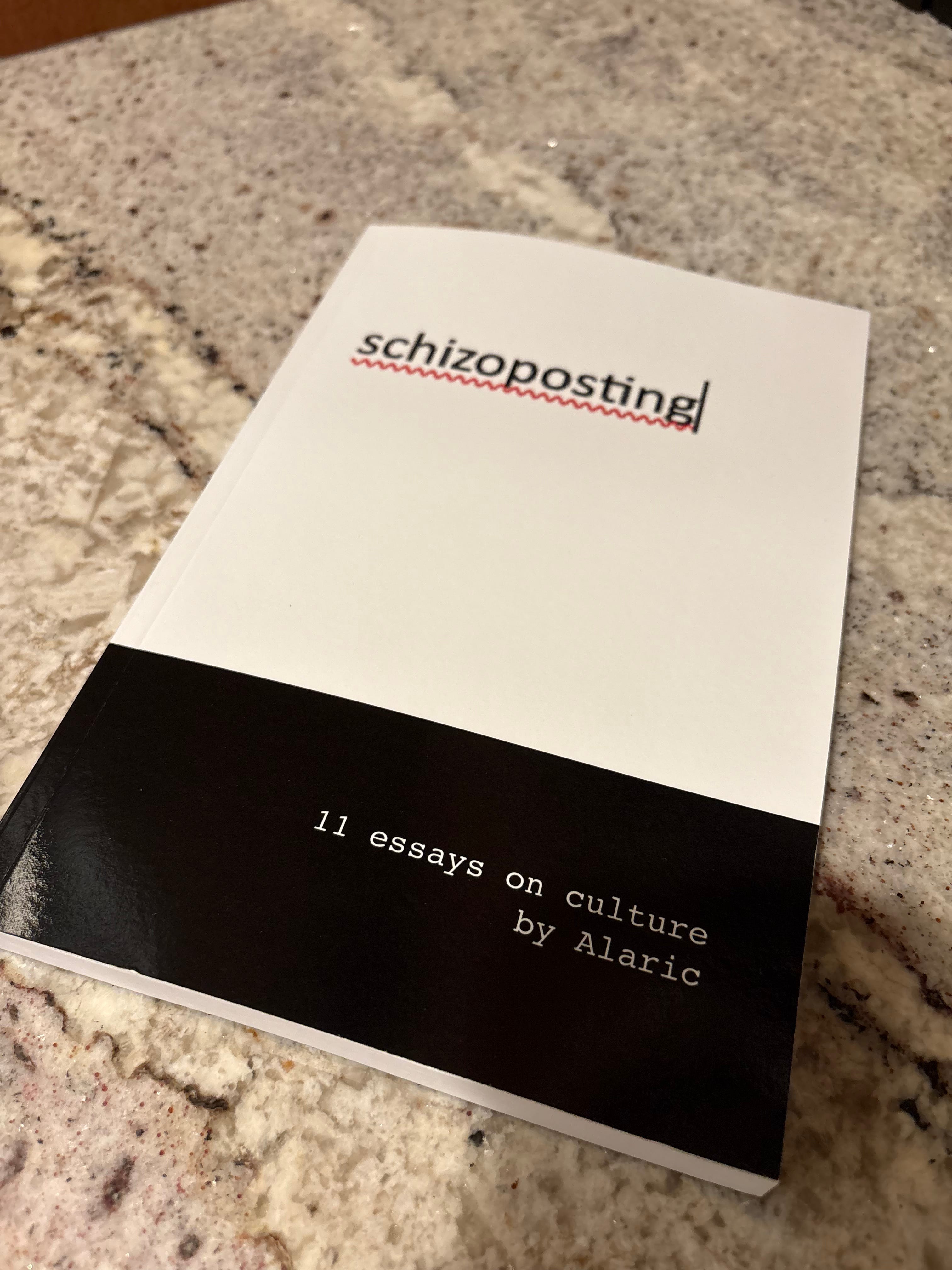
Discourse as ARG is an essay from my new book, Schizoposting. If you’d like a print copy, you can buy it on Amazon. The entire thing is also free as a PDF.
Collins Dictionary.
Cicada 3301 so fascinated the Pentagon that the US Navy launched a copycat ARG in 2014, called “Project Architeuthis.”
Pokémon Go is technically a mixed-reality game, but it leverages the same dynamics, including an interesting PvP dynamic atop the PvE “base” story. Mixed-reality games are merely the next stage of ARGs, in the same sense that Baudrillard’s precession of simulacra functions in stages; in mixed reality, the entirety of the real world can be mediated through the game’s technology with increasingly seamless precision. Zero HP Lovecraft’s God-Shaped Hole extrapolates this concept in horrifying fashion.
Brachmann, Eric and Prisacariu, Victor Adrian, “Building a Large Geospatial Model to Achieve Spatial Intelligence.” Niantic Labs, November 12th2024.
Hence the memetic weight of the term “noticing,” and the leftist’s trained inability to do so.
Lindström B. et al., “A computational reward learning account of social media engagement.” Nature Communications, 2021.
The prisoners of the Cave now puppet the shadows themselves—or at least can determine their actions by shouting at them.
Theorists of magic often invoke Einstein’s “spooky action at a distance” description of quantum entanglement to define “sorcery.”
From the essay “Transeconomics.”
It is notable, however, that as the market has gotten better at reinforcing reality (via advanced analytics and algorithms), high-risk investments have declined in retail availability—supplanted by the de facto adoption of cryptocurrency and online gambling.
An old screed from r/WallStreetBets: “Don’t even ask the question. The answer is yes, it’s priced in. […] Anything you can think of has already been priced in, even the things you aren’t thinking of. You have no original thoughts. Your consciousness is just an illusion, a product of the omniscient market. Free will is a myth. The market sees all, knows all and will be there from the beginning of time until the end of the universe (the market has already priced in the heat death of the universe).”
“Encouraging truthfulness through supervision or reinforcement has been only partially successful [at fixing the LLM hallucination tendency].” Farquhar S. et al., “Detecting hallucinations in large language models using semantic entropy.” Nature, 2024.
Schwab, “The Drone War on Reality.” Schwabstack, 2024.
Iterated Alienation discusses this reverse-construction of media in more detail.
Removed from corporeality or regionality, this is the cyber-territorialization of Schmitt’s friend-enemy distinction.
TikTok merged with musical.ly on August 2nd, 2018. The popularity of infinite-scroll, algorithmically-selected shortform video fundamentally changed the nature of social media, creating its current state.
A now-deleted 2013 blog post by Reddit staff accidentally revealed Eglin AFB as the “most Reddit-addicted city” in the world. Internet outages at Eglin in February 2025 tracked with a complete 180-degree change in political rhetoric on popular subreddits.
One strong example came in the form of the popular response to the assassination of Charlie Kirk, during which media outlets, dozens of pundits (most prominently, Jimmy Kimmel), and thousands of people simply decided that the assassin was a “MAGA conservative” despite all available evidence.
By Angela Nagle (2017). Despite its many flaws, this is one of the only works to seriously engage with the “online culture war.”
I read the whole thing, and though I'm still not sufficiently convinced on the importance of the 2014 revolution being a coordinated affair from on-high, I do like your discussion of the increasing proclivity to treat the real world as though it exists as a McLuhan-esq extension, and the resulting unreality that results as we begin to conflate fantasy and reality that has no direct, immediate tangible effect on our lives. I would care to know your thoughts on McLuhan's media-determinism though, since that consumes so much of his later media analysis, and I enjoy McLuhan as a thinker.